Tuesday, May 23, 2006

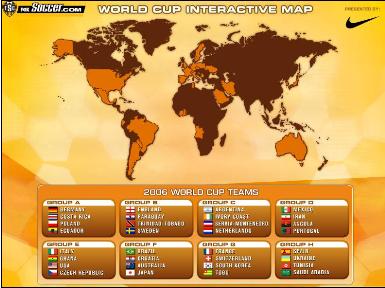
World Cup 2006 Interactive Map


Your quick guide to all 32 teams and countries playing in this summer's World Cup. Launch the World Cup Interactive Map Now!

Wednesday, May 17, 2006

Match the Pairs - World Cup 2006 game


How good is your memory and concentration? Take this test on the football World Cup and its players.

All you need to do is find pairs of similar images hidden in the boxes. Simply click on any of the boxes to reveal the hidden image. Then randomly click on any box to reveal a similar image.

If the second box does not contain the same image then both the images would go back to its original state.

The timer will let you know how long you took to match all the 18 pairs. Start playing the game!


Launch the World Cup game

Thanks to Rediff India.

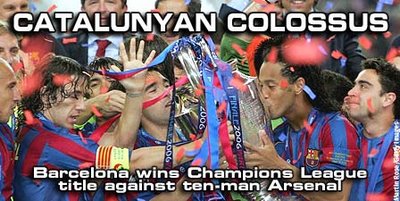
Barca have it all ......


The UEFA Champions League final between FC Barcelona and Arsenal FC promised to be an entertaining epic, but instead Paris witnessed a masterclass of a different kind. Ten-man Arsenal took a first-half lead against the odds and their fabled defence protected it for almost 40 minutes, only for Barça to get their reward for a patient display with two goals in the last 15 minutes, from Samuel Eto'o and Juliano Belletti, to give the Spanish side the trophy for the second time.

Monday, May 15, 2006

How to Build a Computer

Most people just assume that a new computer is a Dell or Gateway. Few people (other than the technically inclined) know that Dell and Gateway skimp on the parts inside the computer. What you're left with is a third-rate computer that costs much more than it should have.

Computers are surprisingly easy to build. Branded computers can offer both value and performance, the parts used can be powerful and cheap, and you can switch on and start work. Yet parts are often short-spec in one place or another. Sadly you'll often get a performance "bottleneck": such as a slow graphics card, only a basic amount of memory, or a slimline motherboard with too few upgrade slots.

If you can afford the time to plan and build your own machine, you can design a system more targeted at your own use:

  • A case-size and colour that stylishly fits your environment. Choose your own keyboard mouse combination, maybe get a rechargeable mouse that doesn't need constant battery changing.
  • Parts that will enhance your specialisms. Different configurations suit (from cheap to expensive):

    • Work and Productivity: Office and Email. A cheap branded PC will do nicely.
    • A Gamer (games playing) Rig. You'll need a killer graphics card.
    • Music Producer. Specialist sound cards offer lots of features and mult-channels.
    • Video Editing Suite. Your processor, hard drive, and memory (some situations graphics card too) are used extensively.
    • Multi-Client Server. You need a really powerful rig that can shift large amounts of data 24/7.

The cost implications of choosing between these uses are huge. A cheap Work computer might cost only two or three hundred. A Server can reach tens of thousands. Choose your setup, and take the advice of experienced users in your field.

You'll only spend the amount of effort and money that gives you a PC that suits your purpose.

We'll assume that you've chosen what your primary use will be. Now we'll build the computer and get it working. Please see the Warnings for cautionary preparations.

Steps

  1. Select your hardware:
    1. Motherboard - This is the base that the other components hook into. Modern boards contain PCI-E(xpress) slots that are much faster than the old PCI. Motherboard makers list compatible cpu and memory products online. You should read them before making your cpu and memory selections. Go to Crucial.com's online memory checker to make sure you select the right memory for your motherboard. You need 8 USB slots (or at least 6) for all your add-on digital cameras, printers, scanners, webcams etc. DFI's LanParty line of performance mobos provide great customizing potential at a great price. Intel makes great mobos if you're looking for a more stable approach.
    2. Graphics - Unless your motherboard had built-in graphics (ok for office work), and you don't plan to do anything graphically intensive (gaming, video editing, etc) you should buy a graphics card. Your graphics card fits into either a PCI-E slot (the current graphics standard), or an AGP slot (a dying interface, but still alive). If you are upgrading an older, manufactorer-built PC, there may be neither of these slots, in which case you will have to use an empty PCI slot to accompany a PCI video card. These mobos almost always have integrated video. Two main chipset makers exist: ATI and NVIDIA. Despite what people say, neither is overall better than the other. Each one makes a card that will fit your needs. If you're an extremely hardcore gamer and you really want to know which one makes the best card, you probably already know how to build a computer anyway.
    3. Processor (CPU) - Intel or AMD. The facts are that AMD show better results in gaming and desktop computing, INTEL have better straightline speeds for data-crunching, AMD Athlons and Opterons are better now, until INTEL can bring its new ranges out. Go for the Athlon 64 model and a socket 939 motherboard as it's not ridiculously expensive and has great value. This is the way to go if you want more upgrade options, or a gaming computer. If you are an Intel fan since they are sometimes said to have more stable timing, go with a Pentium 4 and a socket LGA775 board.
    4. Power Supply - Focal to the computer is the power supply itself. Power Supplies are mainly rated by their power output in watts. A 350W is bare minimum anymore, suitable only for an office machine, while big gaming rigs sometimes need PSUs in excess of 600W.
    5. RAM for your motherboard's memory slots (2,3 or 4 will fill it up). Fast memory is more expensive, sometimes more is better than faster (application dependent). RAM choice is dependent on the motherboard. Go with a stick of 512 MB DDR RAM as the minimum.
    6. Hard Drive - getting cheaper and cheaper (much less than $1 per GB). SATA, the current interface, offers RAID support and faster transfer speeds. All new motherboards are compatible with SATA hard drives. A 7200 RPM drive is crucial (anything less will bottleneck your entire system.)
    • Additional Drives - In addition to the Hard Drive, you will also want to purchase a Floppy Drive and a CD/DVD Drive. The Floppy Drive is fairly standard and will be inserted into your case by opening a side panel and putting it in a vacant bay. After doing so, use a connector from the power supply and a data cable from the motherboard. The CD/DVD drive is similar, but with greater storage capacity per disk and variety of drives (CD, CD-R, CD-RW, DVD, DVD-R, DVD-RW, etc.)
  2. Connect your hardware according to the instructions that come with the motherboard.
    • See Tips and Warnings for safety and continguency advice. Don't leave the hardware on your floor for days while you figure out what you should do.
  3. Now that the inside is done, now we can do the outside:
    1. Case - A mid-size, mini, or micro cube is fine for most users, but a full tower may be needed for servers or users who want a lot of space. Just make sure the tiny box you'd like has enough space for hard drives, DVD recorders and that optional card reader. Running out of space is a pain.
    2. Monitor - CRTs, the large, box monitors, are still preferred by graphic artists for their reliability and color accuracy. However, LCDs are much sharper and will leave your desk less crowded. They also consume less power. It's mainly a money decision.
    3. Keyboard & Mouse - There are expensive gaming and work sets available, for first-person-shooter (FPS) games or designing 3D. Just get a cheap set (wireless is good, less congested) for basic computing. A docking rechargeable mouse is great (no more battery changing!). If you love FPS games, then you should go with a optical mouse that has a nice feel and weight to it. If you have carpal tunnel syndrome then a trackball mouse might be best. They are slightly more expensive, but you don't have to move your wrist at all and you can place them anywhere (leg, table, arm of chair, anything).

Tips

  • Spend no more than is required for your usage. Ignore salesmen or others who implore you to waste money on unneeded upgrades.
  • Frankly it's better to ask nicely and get an experienced geek to source the parts and build the machine. Individual hardware can have niggling incompatibilities that can ruin your user experience. Insist on years of exerience. You'll be glad you did.
  • If you make the machine yourself, do as much research as possible. Choose parts that are likely to work well together. Read about configurations that have worked well for other users.
  • The more preparation, research and careful selection of parts you do (and making it), the less proportion of your life you will spend making the darn thing work.
  • Well, that's all you need in order to build computers, but you still have the need of an operating system (Windows, Mac, Linux). Most people have Windows and know it well, but Mac users are very happy with their incredible ease of use, and lack of problems (no viruses on mac!). Linux is great, but a steep learning curve.

Warnings

  • Be careful of ESD (Electrostatic Discharge) when putting it together. Wear a static wristband (available from stores), or at least regularly ground yourself.
  • Double or triple check all connections before switching on the computer for the first time.
  • Avoid spilling coffee/tea. Computers hate liquids.

How to Choose Between a Personal Computer Vs a Macintosh

Gates or Jobs? Whom do you want to support? Here's a guide to help you decide whether you want to buy a PC or a Mac computer.

Steps

  1. Decide how much you have to spend. If you're not sure if it's worth paying the price for a Mac, try a Mac mini first. They start at around $500 and may actually fulfill all your requirements. A handbuilt PC costing $500 will take up more space on your desk, but can be much more powerful.
  2. Decide what you want your computer to do. If you want to do high-end video editing and graphic design, you may choose a Mac for this job. PCs and Macs are both good for doing day-to-day tasks.
  3. Consider your choice of operating systems. While Windows has its instabilities, Mac OS X in most cases is far superior and more ahead than even the newest, most up-to-date Windows operating systems. Mac operating systems tend to be much more secure, and offer a very easy-to-use interface with many included applications and intuitive features. Windows also has a multitude of viruses for it, while there have only been a handfull identified for Macs.
  4. Macs have less of a software selection, but there are quite a few decent programs for the platform. Most commonplace programs are available on the Mac. Microsoft Office, most Adobe products, and most major software have Mac counterparts.
  5. If you want a cheap disposable workhorse, or want to play games, PCs are best. Mac users have a quasi-religious devotion to their computers which is well founded: few switchers from PCs to Macs ever go back.
  6. If you want a PC, but want OSX, get PearPC, a free Mac emulator, and install Mac OSX with it. Alternatively VirtualPC installed on a Mac can run most windows software with some preformance loss. A third method to get a computer with dual Mac/Windows functionality is to purchase an Intel based Mac and install Bootcamp from Apple. This allows Intel based computers to boot either OSX or Windows, meaning that the computer is both PC and a Mac. (note that Bootcamp is still Beta software, meaning that it is not fully supported though it has already been successfully deployed by many users)
  7. Instead of Windows, you can try Linux, a free and much more reliable OS that is based on UNIX. There are many distributions available, visit the official website at http://linux.org/ . If you eventually decide on Windows but still want linux functionality, you can download and run WinLinux from http://www.winlinux.net/

Tips

  • Macs may be more expensive, but keep in mind that it includes a lot of applications that the PC doesn't include. Apple has great tech support. Macs are also proven to last longer and are more reliable than PC's.
  • While there is a 'stereotype' of sorts about the price of Mac computers, investigation will reveal that prices are more comparable now than they ever have been. The newest Macintosh computers are made with Intel processors, which should help to further bring down the price.
  • PC systems can handle high-end video editing and high-end graphics as well as Macs, although PC solutions will cost much more.
  • Avoid the salespeople at "Big Box" electronics stores who usually know little about computers and a lot about this week's special offer. Talk instead to a devotee of either the PC or Mac platform before making your choice. Get both to show you what each machine can do with the software that comes with the machine.
  • Macs, by nature, cannot be exploited by Windows viruses. Also, there is much less of a spyware/adware problem, because most spyware/adware is written targeting vulnerabilities in Windows operating systems.
  • If you decide on a Mac, you'll want to buy it either at an Apple Retail store (http://www.apple.com/retail/) or from the online store. Most mainstream retailers do not carry Macs (with exception to CompUSA and a few others), so you'll probably end up going directly from Apple. Places like Apple's online store (http://store.apple.com) and MacMall (http://www.macmall.com) are geared toward Macs and offer all Mac products.
  • It is not a good idea to build a $500 computer. If you are going for the bargain basement it is almost always better to go to a big company like Dell. You will get a slightly better computer for the low price because large companies sell the bottom end machines as 'loss leaders' to get people to buy from them. With the purchase you will also get tech support and a warranty that you will not get if you build your own. However, more expensive computers with premium components are almost always cheaper to build and in general the more you are willing to spend the bigger the price difference between building your own and buying an 'out of the box' computer.

Warnings

  • If you are switching from a PC to a Mac or vice versa, you will have to adjust to some minor keyboard differences (i.e., you will use the command key instead of the control key in most instances when switching from PC to Mac).
  • Think before you buy.

Sunday, May 07, 2006

Top Ten Digital Photography Tips

You've heard this before: Digital cameras do all the work. You just push the button and great pictures magically appear. The better the camera, the better the photos. Isn't that right? Heck no!

The truth is that you can make great photos with a simple consumer point-and-shoot camera, or take lousy shots with the most expensive Nikon. It's not the camera that makes beautiful images; it's the photographer. With a little knowledge and a willingness to make an adjustment here and there, you can squeeze big time photos out of the smallest digicam.

for more go to Top Ten Digital Photography Tips by Derrick Story

Thursday, April 27, 2006

Fifa World Cup 2006 Predictions

Second Round
24 Jun 17:00 Poland 0-1 England
24 Jun 21:00 Netherlands 2-0 Mexico
25 Jun 17:00 Sweden 2-1Germany
25 Jun 21:00 Portugal 0-1Argentina
26 Jun 17:00 Czech Republic 1-0 Croatia
26 Jun 21:00 France 1-1 Ukraine (penalty)5-2
27 Jun 17:00 Brazil 3-1 Italy
27 Jun 21:00 Spain 1-0 Switzerland

Quarter Finals

30 Jun 17:00 England 1-2 Netherlands
30 Jun 21:00 Czech Republic 1-2 France
1 Jul 17:00 Sweden 0-2 Argentina
1 Jul 21:00 Brazil 2-0 Spain

Semi Finals

4 Jul 21:00 Netherlands 2-1 France
5 Jul 21:00 Argentina 2-3 Brazil

Third Place Play-Off

8 Jul 21:00 France 1-2 Argentina

Final

9 Jul 20:00 Netherlands 0-2 Brazil

World Champion 2006 Brazil

How to Annoy Telemarketers

Note: this is an unofficial guide to annoying the stupid people who get paid to drone on and on about a stupid company. This includes several different methods to annoying these seemingly idiotic people who practice this barbaric ritual that no one needs.
Steps
1. Talk like Dr. Phil, the psychologist. Pretend you know exactly what their problems are and convince them that they're possessed.
2. When they ask for a phone number, give Pizza Hut's phone number.
3. Talk like Yoda the entire time. Say things like "Idiot you are, imbecile."
4. Talk like famous celebrities, like George Bush or Arnold Schwarzenegger.
5. Mimic them like a parrot; when they ask you to stop, say "I'm the customer, dammit".
6. Talk as if you have something important to do all the time. Don't hang up.
7. Put them on hold for at least three minutes, then hang up.
8. Pretend you are cheating on your girlfriend while you're on the phone.
9. Wait and don't say anything. Go to the nearest computer and become mezmerized by the screen saver.
10. Act like a priest
11. Ask them for their home phone number. When they say no say "Oh, you don't want annoying people calling you at home. WELL NEITHER DO I!!!".
12. Fake a selection of noises in the background (gunshots).
13. Try and sell them something.
14. Laugh like a maniac every so often.
15. Sing loudly.
16. Blow down the phone.
17. If they are selling a "friends and family" package, tell them "I have no friends. will you be my friend?".
18. If possible, play the crazy frog tune down the phone. Full volume.
19. When asked if you want to buy something, just say "ok, but make it quick. I've got two dead people in the basement and a third with a knife through the ear".
20. Interrupt them with pointless questions.
21. Fake remembering them (e.g. Mark? Is that you? oh, hey, it's me, John. Remember me? From bedwetters camp? Oh, I've been trying to contact you for aaages. How's it hanging?"
22. Make it sound as though you are currently on the toilet.
23. make it sound as though you are a criminal. (e.g. Oh g-d, it's the cops. Look, I don't know how six tonnes of marajuana and two crates of illegal firearms got into my backyard. It just did, ok! I'll take it to you, but remember- the mob are gonna kill me, and possibly you for this.
24. State very scary "facts" (e.g. Did you know that twelve percent of murder victims are telemarketers?).

Tips
* You can simply ask them to put you on the no-call list; if they call you ever again, they are breaking the law.
* You can just hang up the phone the moment you know who it is!!

Warnings
* Remember that some of these people, are putting themselves through college, or might be supporting a family. They are only doing their job, and some people buy what they are selling, so its not a good idea to be disrespectful to them. When they call, its best to just hang up!
* Be cautious of what you actually say.

Monday, April 24, 2006

The Famous Five – Players to watch in the 2006 World Cup

SAVIOLA Javier - Argentina
An exciting and mobile striker with a keen eye for goal, Javier Saviola burst on to the scene as a teenager with hometown club River Plate. He won the Golden Boot and Best Player awards at the 2001 FIFA World Youth Championship where he scored a tournament-record 11 goals. He moved to FC Barcelona in 2001 where he averaged just under a goal every two games in three seasons before spending the 2004/05 campaign on loan at AS Monaco. Scored three goals as Argentinareached the 2004 Copa America final and also played a part as they won gold at the 2004 Olympics. Is nicknamed 'El Conejo' - or The Rabbit.

RONALDINHO -Brazil

Despite possessing shooting skills and ball control that verge on the supernatural, Ronaldinho Gaucho still blushes when he is compared to legendary Brazilians like Pele or Zico. He also asks with typical modesty not to be placed on a pedestal with other greats like Garrincha, Didi or Dada. But it seems his pleas are destined to fall on deaf ears. Fate looks to have a special place reserved for him among the pantheon of Brazil greats.

But it was as a member of Brazil's winning side at the 2002 FIFA World Cup Korea/Japan that the 25-year-old really came of age. Things did not look too promising at the outset, with the fanatical Brazilian public expressing their preference for Romario. However, then coach Luiz Felipe Scolari opted for Ronaldinho, and the youngster justified the faith put in him. Asked once to reveal the secret of his success, he answered: "No matter where you go or what you do in the world, it is noteasy to find an opening. When two teams are technically very similar, as is often the case in Brazil, then you have to want it more, fight until the death and never give in."

BALLACK Michael-Germany
If he plays well, the scribblers generally say "Ballack could do better". If he is average, the same question always poses itself: "What was wrong with Ballack today?" If Oliver Kahn ships too many goals, "Ballack was playing too offensively". If things are not going well in the final third, "Ballack was sitting too deep". In fact, only when he has a truly outstanding game do we read: "Today we saw the real Michael Ballack".

It isn't easy being the German captain. The midfielder has long abandoned the notion that he can make everything right. However, it often seems that scarcely anybody is satisfied with his performances and, ironically, his completeness as a footballer makes him a prime candidate for a scapegoat. After spells with Chemnitzer FC, FC Kaiserslautern and Bayer Leverkusen, the "most prolific goal-scoring midfielder in the world", according to club boss Karl-Heinz Rummenigge, arrived at record German championship winners Bayern Munich in 2002. His contract ends before the coming World Cup, and Chelsea are on the verge of stealing him before the start of the World Cup as other clubs sit back and watch the color of money.


Lionel MESSI - Argentina
Lionel Messi became the toast of Argentina when, just days after his 18th birthday, he inspired his country's U-20 side to a fifth world title with a series of masterful displays at the FIFA World Youth Championship Netherlands 2005. Such was the impression made by the prodigious midfielder that in addition to taking home a gold medal he also picked up the adidas Golden Shoe award as top scorer, and the adidas Golden Ball as best player. At 2006 FIFA World Cup Germany, the 18-year-old could well be in the running to pick up a brand new award - the Gillette Best Young Player Award.

'Messimania' has also broken out back in Argentina with many supporters and analysts already comparing him to the young Diego Maradona. Indeed 'El Diego' himself was so taken with the youngster's mercurial displays that he personally phoned to offer his congratulations and encouragement.

Wayne Rooney - England

Wayne Mark Rooney is widely considered to be one of the leading young talents in world football - in September 2005 he was selected by his fellow professionals as the inaugural FIFPro World Young Player of the Year. He currently plays for Manchester United and the England national football team as a second striker, although the 2005-06 season has seen Rooney playing both centrally and on the left and right flanks. He wears the number 8 shirt for his club, vacated by Nicky Butt, and is generally given the number 9 for his country.

Although he has been under an intense media spotlight since first arriving on the scene in 2002, it was not until his performances at the Euro 2004 that he gained a reputation on the world stage, as he spearheaded the English attack, scoring 4 goals - England coach Sven-Goran Eriksson compared his impact to that made by the legendary Brazilian, Pelé at a similar age during the 1958 World Cup - this comparison has led to him being nicknamed "El Blanco Pelé" - the white Pelé - by some United fans.

Sunday, April 23, 2006

The ADIDAS GOLDEN BALL AWARD

The adidas Golden Ball award is presented to the outstanding player at each FIFA World Cup™ finals, with a short-list drawn up by the FIFA technical committee and the winner voted for by representatives of the media.

Past winners of the prestigious adidas Golden Ball award include famous faces such as Germany goalkeeper Oliver Kahn in 2002, Brazil’s Ronaldo in 1998, Italia 90 hitman Salvatore Schillaci and Argentina’s 1986 World Cup™ winner Diego Maradona.

Every FIFA World Cup™ finals produces one outstanding player destined to leave an indelible mark on the tournament in question. Beginning in 1982, FIFA and adidas have recognised the exceptional performers by awarding the adidas Golden Ball at the end of the event.

The Golden Ball is arguably the most coveted individual trophy in the world game. At the 2002 FIFA World Cup Korea/Japan™, Germany's Oliver Kahn became the first goalkeeper to claim the prestigious award, accepting a newly-created version of the trophy inscribed with the names of all previous winners.

Alongside Kahn, the glittering prize has gone to Paolo Rossi (Italy), Diego Maradona (Argentina), Toto Schillaci (Italy), Romario (Brazil) and Ronaldo (Brazil). The names of all future winners will be added after each tournament.

The award procedure involves the FIFA technical committee nominating a shortlist of ten contenders following the semi-finals, before media representatives meet at the play-off for third place to elect the winner of the Gold, Silver and Bronze Balls.

The new design commissioned by adidas is based on the historic Chile ball created by the equipment manufacturer in 1960 and remains in adidas and FIFA's possession. The world governing body keeps the trophy on permanent display at FIFA House in Zurich.

Previous winners:

* 1982 Spain Paolo ROSSI (ITA)
* 1986 Mexico Diego MARADONA (ARG)
* 1990 Italy Salvatore SCHILLACI (ITA)
* 1994 USA ROMARIO (BRA)
* 1998 France RONALDO (BRA)
* 2002 Korea/Japan Oliver KAHN (GER)

Friday, April 21, 2006

300 freeware utilities for any task

Need to burn a CD? Manage your wallpapers? Undelete a file? Keep a to-do list? Here's a big list of freeware apps for Windows that will help you do those things and about 300 other tasks. It's a pretty nice list hand-selected by humans. I've got it bookmarked for the next time I need an app for some one-off task but don't want to spend an hour browsing shareware sites.

The forgotten man -- Ronaldo finds himself with an odd label: underrated


Ronaldo Luiz Nazario de Lima has been in the international-soccer spotlight for more than a decade and during that time he has been called many things: phenom, prodigy, the next Pelé. But "underrated" never has been one of them.

Heading into the World Cup, however, that's the only word that comes to mind when I think of Ronaldo.

While Brazilian soccer fans have hyped sensations such as Ronaldinho, Adriano and Robinho (whom Real Madrid signed for $30 million to push you-know-who for his job), Ronaldo has sat by idly, unfazed by his fading star, unmoved by the attention that has gone to players whom he believes he is still better than. He knows that, in time, they all will be judged by the same barometer that all Brazilian players are judged by in their careers: World Cup trophies, the same golden statuettes that seem to serve as the chapter points in Ronaldo's career.

"We can never judge the lives of others, because each person knows only their own pain and renunciation."
-- Paulo Coelho, Brazilian novelist


No one can say truthfully they know what Ronaldo has gone through in his life, because no one has experienced a career full of as many ups and downs that have been chronicled on such a global stage as he has.

He grew up in poverty, playing soccer in the outskirts of Rio de Janeiro, signed a multimillion-dollar professional contract and won a World Cup at the age of 17; was blamed globally for single-handedly losing the World Cup in 1998 when he played poorly after suffering from a mysterious illness the night before the final; nearly retired from the sport after several knee operations that sidelined him for over two years; and finally redeemed himself by leading Brazil to World Cup glory, winning the Golden Boot award and scoring the final's only two goals.

As he sat in the back of a black Escalade parked outside of a youth center in Los Angeles, listening to him talk about a career that has spanned three World Cups (and counting) and four major European clubs (and counting) it was hard to believe Ronaldo is only 28 years old.

While he gazed out at the hundreds of children chanting his name, he finally smiled, revealing the famous gap in his front teeth that has become as synonymous with Brazil as the samba. Despite being hampered by a strained hamstring that will keep him out of an exhibition game with the Los Angeles Galaxy later in the day, the Real Madrid striker is loving life.

He has come to terms with the perception that his country no longer needs him to win its sixth World Cup after it won the Confederations Cup without him last month. He knows that's not really the case and plans on holding another gold trophy in his No. 9 yellow jersey before retiring from international play 2006.

"It'll be my fourth World Cup and I have to let younger players take their chance," he says.

He is OK with the notion that his best years are behind him and that his three-year stint at the Bernabeu has been a disappointment because he's led Real Madrid to only one league title and no Champions League crowns since coming over in 2002 for $35 million.

"I understand that soccer is all about how well you played in your last game, and I am confident that I'll find success here before I retire here."

He is even at peace with the fact that his personal life -- his marriage to model Daniela Cicarelli lasted about three months before ending in divorce this year -- often gets more press than his professional accomplishments. "That's just part of being a recognized soccer player."

He is fine with all that because he doesn't care how people perceive him or care to meet the standards placed upon him by others who don't know him. He is content with where he is in his life, personally and professionally, although there is one frontier that many feel still awaits him: one final tip of the cap to Pelé, the man to whom Ronaldo has been linked since childhood, and the player he will likely pass on the World Cup-goals-scored list next year.

While Ronaldo says he plans to play out the final four years of his contract with Real Madrid and retire with the Spanish giants, he's never ruled out the possibility of pulling a Pelé and finishing his career in the States.

It's a decision that makes sense for Ronaldo, who has vacationed in the States the past few summers, enjoying the sun-kissed beaches of Miami and Los Angeles while improving his English. While David Beckham may think he will have a strangle hold on the U.S. soccer scene when he retires from European club play, Ronaldo could have an even larger impact here than Becks.

Not only is Ronaldo arguably the greatest striker of our generation and one of the biggest heroes in the Latino community, he is the only player who can match Beckham's pop-culture cache in the U.S. Need more proof than the bevy of models Ronaldo has been linked to, the lucrative endorsement deals he has signed and the infamous hair styles he's made popular? Look no further than one of the most popular women's athletes.

During the Real Madrid-Galaxy game at the Home Depot Center in Southern California, tennis superstar Maria Sharapova stood and watched the game from a suite above the home goal and fiddled with her cell phone as she eagerly awaited the game's conclusion so she could meet her favorite player.

"I'm here to see Ronaldo," she said, dressed in a tight vintage top and acid-washed jeans. "I've always been a big fan of his no matter what club he's on."

Although the possibility of seeing Ronaldo play out his career in Los Angeles or New York might seem remote, the possibility of attracting millions of new fans in the States and millions of dollars in new endorsements may be too much to pass up in the twilight of his career.

If Ronaldo ends up winning another World Cup this year and captures a Champions League medal before he retires from European Club Football, there would be no better way to finish his career than a final victory stint in the U.S. At the very least, if he plays in the MLS, even at the end of his career, the last thing he'll be known as is "underrated."

"The God that people venerate does not carry a cross ,
Ask the footballing world my god carries a number "9" on his back".
-- Avinash Shetty, Ronaldo Fan for Life
European football 101--Follow basics and you'll love the sport as much as I do

It's a conversation I endure regularly this time of year. Friends and co-workers are a) bewildered that I watch European soccer almost as much as any U.S. sport and b) confused by the number of leagues and tournaments that will culminate in the coming weeks.

The notion that there could be more than one "major league" in a particular sport and about half a dozen trophies just as prestigious as the Vince Lombardi is as foreign to them as the grounds that these matches are played on. So for them and for you, readers who might also be confused by the wide word of European football, here's a crash course on the subject.

For viewing convenience, we will highlight the five "top tier" soccer leagues in Europe: the English Premier League, Spanish Primera Division ("La Liga"), Italian Serie A, French Ligue 1 and the German Bundesliga, with apologies to the Portugal SuperLiga and the Dutch Eredivisie. These five leagues are very similar in structure. Each is comprised of the top 20 teams in their respective countries (the Bundesliga only has 18 teams), with each team competing against each other twice, once at home and once away, for a total of 38 matches per season (34 for the Bundesliga). At the end of the season, the team with the most points (three points for a win, one point for a tie) wins the league championship. There are no playoffs, tournaments or BCS computers involved. Much like college football, the season is the playoff and every game means something.

In addition to league play, which runs from about mid-August through mid-May, there are also several other tournaments that teams compete in that have nothing to do with league standings. The most prominent is the UEFA (Union of European Football Associations) Champions League, an 11-month competition in which 74 teams from 52 countries compete to determine the top football club in Europe. You've probably stumbled upon a few of these games on a Tuesday or Wednesday afternoon on ESPN. Another is the UEFA Cup, a similar competition for top European clubs that fail to qualify for the Champions League and those that are knocked out of the Champions League before the 32-team group stage. Think of it as the NIT to the Champions League's NCAA basketball tournament.

At the end of each season, the top two teams in each of the top five leagues automatically advance to the group stage of the Champions League, while the third- and fourth-place finishers advance to the third qualifying round of the Champions League. (The Bundesliga and Ligue 1 only send their third-place teams.) The teams ranked fifth and sixth in the leagues (fourth and fifth in France and Germany) advance to the UEFA Cup, as does the winner of each country's annual domestic cup competition, the FA Cup (England), Copa del Rey (Spain), Coppa Italia, Coupe de France and German Cup. Also, the bottom three teams in each league are relegated to the country's second division -- the Football League Championship (England), Segunda Division (Spain), Serie B (Italy), Ligue 2 (France) and Second Bundesliga (Germany) -- while three of the top teams in that lower division are promoted.

Can you imagine if this was the case with American sports leagues? Take, for example, the NBA last season. The Detroit Pistons would have been awarded the league championship at the end of the season, the San Antonio Spurs would have likely won the domestic tournament and the New York Knicks, Portland Trailblazers and Charlotte Bobcats would have been relegated to the D-League while the Fort Worth Flyers, Albuquerque Thunderbirds and Florida Flame would have been promoted to the NBA, finally setting up that dream interstate matchup between the Heat and the Flame we've all been waiting for.

For fans in the States, who are used to watching one top league to which the best players in the world come to compete, and where every team has one singular goal -- winning the league title that is often referred to as a "world championship" -- European soccer, or international soccer in general, is not the easiest sport to follow or understand, since most clubs begin the year with dreams of holding two ("the double") or three ("the treble") trophies at season's end. There aren't many casual fans who have the time to follow the hundreds of teams that play in the dozens of leagues and tournaments abroad. And of the top six or seven leagues, no one league can truly say it's better than another and no team can claim to be the "world champion." Simply look at the Champions League for confirmation -- five different teams from five different countries have won the competition the past five years.

For soccer fans, however, there's nothing quite like it. There's never an offseason. Most leagues and competitions run for about 10 months. International tournaments, such as the World Cup and the European Football Championship, along with friendlies and preseason matches, take place during the short time leagues aren't in place. For most soccer fans abroad, the sport isn't so much followed as it is lived, with every match dictating the lives of its supporters. As legendary football manager Bill Shankly once said, "Some people believe football is a matter of life and death. I'm very disappointed with that attitude. I can assure you it is much, much more important than that."

Netherlands could win it all -- or flop spectacularly

FIFA world ranking: No. 3.

How they qualified for Germany:
Won UEFA Group 1 with a 10-2-0 record. The Oranje conceded only three goals in 12 matches and finished five points ahead of No. 2-ranked Czech Republic, which it beat twice.

Previous World Cups:
Seven appearances (1934, '38, '74, '78, '90, '94, '98), runner-up in '74 and '78.

Manager:
Marco van Basten, third year with team.

Key players:
At 6-foot-2, Ruud van Nistelrooy is a big man who loves the big stage. The joint second top goal scorer in Euro 2004, "Rutergus" has also been prolific while playing for the world's most famous club, Manchester United. He has topped the European Champions League scoring charts three times and the English Premier League charts once. Critics will point to signs that van Nistelrooy is out of form, primarily his start-and-stop season with United that has led to rumors of an impending departure from the club. Still, with his record of lethal finishing, strength, power and determination, van Nistelrooy could end up being the top scorer in Germany if the Netherlands reach the late rounds.

Like van Nistelrooy, Arjen Robben left PSV Eindhoven to ply his trade in the EPL, joining Chelsea in the summer of 2004 for $22 million. Robben's pace, dribbling skills and ability to beat defenders makes him a regular on the Dutch national team; he has scored six goals in 17 matches to become a firm fan favorite. Much of Holland's hopes will rest upon the young star's shoulders. He'll be expected to create chances for the attack -- a burden that hasn't been helped by the goal drought that has recently hit Bayern Munich striker and '02-03 European Golden Boot winner Roy Makaay. For Robben to succeed, he'll need to be focused and avoid the disciplinary problems and diving tendencies that have seen him red-carded twice this season.

What to watch for:
The Dutch have a long tradition of playing a highly skilled, fluid and technical variety of soccer -- think of a mix of Brazil's flamboyance and Germany's discipline. In 1974, the Oranje reached the World Cup final, and the world marveled at its flair, especially the skill of Johan Cruyff and his famous "turn." In the '80s Rinus Michels masterminded his brand of "total football" at Ajax before winning the '88 European Championship with the Dutch national team.

Since then, a lack of team spirit and togetherness has haunted the Dutch, culminating in 2002 when they failed to qualify for the World Cup. Since then a new crop of players has come through the ranks to stand alongside a solid group of established stars. If team leaders Edwin van der Sar and Phillip Cocu -- not to mention their legendary coach, van Basten, who retired as a player prematurely -- can get this squad to work as a unit, expect total football. If not, expect another frustrating mid-round exit.

Group: C (Argentina, Ivory Coast, Serbia & Montenegro).

Key match in group stage:
June 21 vs. Argentina. This contest will probably determine who tops the group. Although both Serbia and the Ivory Coast are competent teams, the Dutch and the Argentines are both potential winners of the entire tournament.

Oddsmakers' line: 14-1.

Projected Starting Lineup:
Pos. Player Club team
G Edwin van der Sar Manchester United (England)
D Jan Kromkamp Liverpool (England)
D Khalid Boulahrouz Hamburg SV (Germany)
D Barry Opdam AZ Alkmaar (Netherlands)
D Giovanni van Bronckhorst FC Barcelona (Spain)
M Philip Cocu PSV (Netherlands)
M Mark van Bommel FC Barcelona (Spain)
M Rafael van der Vaart Hamburg SV (Germany)
F Arjen Robben Chelsea (England)
F Dirk Kuyt Feyenoord (Netherlands)
F Ruud van Nistelrooy Manchester United (England)

Friday, April 07, 2006

For Brazil, anything less than title is a disappointment

FIFA world ranking: No. 1.

How they qualified for Germany:
Finished first in CONMEBOL qualifying with a 9-7-2 record, the same point total as Argentina but a superior goal differential.

Previous World Cups and finishes:
The only nation to appear at all 18 tournaments since 1930. Champions in 1958, '62, '70, '94, 2002. Runner-up in '50, '98; third place in '38, '78; fourth place in '74.

Manager:
Carlos Alberto Parreira, fourth year with squad.

Key players:
Brazil wouldn't be defending world champion without its hero of the 2002 Cup. Ronaldo is back for this go-around, but he'll be nearly 30 when the Brazilians kick off in Germany, and he's definitely lost a step. His place in the starting lineup is safe -- for now. Hot on his heels is 22-year-old Robinho, who is ready to blossom into the next ambassador of the trademark Brazilian brand of soccer that combines extreme skill with flamboyant style. Pelé himself declared that if someone can ever get close to what he was, that player is the so-called "prince of dribbling." Robinho is still maturing, which is frightening considering that he's growing up under the ridiculous microscope that is Real Madrid.

Of Brazil's young players, Ronaldinho is definitely the most experienced. The 26-year-old Barcelona star has reached the pinnacle of world soccer, having won back-to-back FIFA World Player of the Year awards. He has accomplished all this with a smile on his face, unlimited talent at his feet and a giant amount of motivation to write his name in World Cup history. In fact, the leader of the Seleção will wear the No. 10 jersey in Germany, an honor that belonged to Pelé and was last worn by Rivaldo. The difference, explains Ronaldinho, is that those Brazilian legends "had to open the way to the goal by themselves -- they were the lifesavers of the team. Now, with Kaká, Adriano and others by my side, the work becomes easier."

Adriano in particular will make Ronaldinho's job loads easier. Amazingly, this will be the first World Cup for "the Emperor." The 24-year-old Inter Milan striker is big -- 6-foot-2, 190 pounds. He'll be expected to add muscle up front and make up for what Ronaldo now lacks: speed, power, long-distance accuracy and leaping ability to head down crosses and corners. He's often called the best striker in the world, but he still has plenty to prove on the world's biggest stage.

What to watch for:
With such high expectations, it's never easy to be Brazil -- but it's definitely worse when the Brazilians are considered heavy favorites. Every time the Seleção have been tabbed to win the World Cup, they've failed to display any kind of calm or peace of mind. Ronaldo's illness was a distraction in France '98. When Brazil fielded perhaps its most talented squad ever in Spain in '82, it suffered a disastrous defeat to Italy in the quarterfinals. This year, Brazil is again heavily favored, and this current squad is wildly talented. How it deals with the pressure is a big question mark.

All that talent is another big issue facing head coach Parreira and assistant (and former boss) Mário Zagallo: Which attacker will they bench, Adriano, Ronaldinho, Kaká, Robinho or Ronaldo? The current system allows for only four places, which means one of the stars will have to come off the bench. Age is another worrying factor on this team: Not only is Ronaldo getting on in years, but defensive stalwart Roberto Carlos will be 33, while captain Cafu will be 36.

At the same time, Brazil has never had such a lineup of stars, from the famous coaching staff all the way down to the laundry list of international celebrities. For better or for worse, this World Cup is Brazil's to lose.

Group: F (Japan, Croatia, Australia).

Key match in group stage:
June 13 vs. Croatia. Brazil's first game against perhaps its toughest opponent will say a lot about its emotional response to the pressure. Parreira is preparing all his weapons to focus first and foremost on this match -- he knows that a draw or a loss will create severe turmoil in the Brazilian camp. A win will assure a more relaxed atmosphere against Australia and Japan.

Oddsmakers' line: 11-4.

Projected Starting Lineup
Pos. Player Club team
G Dida AC Milan (Italy)
D Cafu AC Milan (Italy)
D Lúcio Bayern Munich (Germany)
D Roque Júnior Bayern Leverkusen (Germany)
D Roberto Carlos Real Madrid (Spain)
M Emerson Juventus (Italy)
M Zé Roberto Bayern Munich (Germany)
M Kaká AC Milan (Italy)
F Ronaldinho FC Barcelona (Spain)
F Ronaldo Real Madrid (Spain)
F Adriano Inter Milan (Italy)